
How Cannabis Strain Categories Work in Thailand
Quick answer
Thai dispensary menus sort cannabis into four rough buckets: sativa-leaning, indica-leaning, hybrid, and CBD-forward. Those labels point at lineage and a general reputation, but they don’t tell you much on their own. The terpene and flavor profile, meaning the aroma compounds a plant produces, explains far more about how one variety differs from another than the sativa or indica tag does.
Key facts
- Most menus in Thailand group flower four ways: sativa-leaning, indica-leaning, hybrid, and CBD-forward.
- The sativa-versus-indica split is a sorting habit, not settled science. Researchers now weigh cannabinoid and terpene content more than the old binary.
- Terpenes are the aroma compounds behind a strain’s smell and flavor, and they vary widely even inside a single category.
- CBD-forward varieties are set apart by a higher balance of CBD to THC, not by where they sit on the sativa or indica family tree.
- Siam Green runs five branches in Thailand: Phrom Phong, Silom, Nana, Chinatown, and Chaweng (Koh Samui), where staff can talk through terpene profiles in person.
Siam Green has five branches in Thailand: Phrom Phong, Silom, Nana, Chinatown, and Koh Samui (Chaweng).
Thailand’s cannabis scene has changed fast since the 2022 policy shift. What started as a legal change has grown into a sizable industry, and it has reshaped how locals and visitors talk about the plant. From the streets of Bangkok to the beaches of Koh Samui, the labels you see on a shelf draw on a mix of international strain naming and Thailand’s own herbal traditions. The result can be confusing the first time you read a menu.
Our team has worked around Thai cannabis since 2022, and the question we field most is some version of the same thing: what does this label actually mean? This guide answers that. It walks through the four categories you’ll run into, what each one tells you, and where the label stops being useful.
How Cannabis Strain Categories Work in Thailand
The four categories you’ll see on Thai menus
Walk into a dispensary from Sukhumvit to Chaweng Beach and the flower is usually grouped four ways. Here is what each label is telling you, and where it stops carrying real information.
Sativa-leaning
Sativa-leaning varieties sit at one end of the old spectrum. The reputation that comes with the label is built on grower lore and customer habit more than a firm rule, and plenty of sativa-tagged flower doesn’t match the stereotype. What the label reliably signals is lineage, not a guaranteed character.
Tropical Tsunami is a useful example. It carries a bright orange and citrus profile, the kind of terpene signature people tend to file under the sativa side. The flavor is the concrete thing you can actually check on the shelf. The category is just the loose bucket it sits in.
Indica-leaning
Indica-leaning is the other half of the old binary. Same caveat applies here: the genetics behind the tag are real, but the tidy split is approximate.
Permanent Marker is a widely recognized indica-leaning variety, identifiable by a rich floral and earthy aroma. It picked up broad attention after being named Leafly’s Strain of the Year in 2023. The name recognition is why it comes up in conversation, but the aroma is what tells you what you’re actually smelling.
Hybrid
Most flower on the market today is a hybrid, a cross that pulls from both sides of the family tree. The hybrid tag is arguably the most honest of the three, because pure sativa or pure indica is rare now.
Ultra Mango Haze shows how this plays out. It’s a hybrid with a sweet, tropical mango note on the nose. The mango-forward terpene profile is the distinguishing trait, not the word “hybrid,” which only tells you the lineage is mixed.
CBD-forward
CBD-forward varieties are the outlier of the four. They’re defined by chemistry rather than by the sativa or indica family: a higher proportion of CBD relative to THC. Because the balance of CBD and THC shapes how a variety reads, this group sits apart from the other three on the menu.
Charlotte’s Angel is a common reference point, a CBD-rich variety low in THC with fruity, pine, and mango notes. It illustrates the category cleanly: same plant family, different chemistry.
Why terpenes tell you more than the category does
Here is the part the sativa or indica tag can’t cover. Two plants can share a category, sit side by side on the shelf, and smell completely different, because their terpene makeup differs. Terpenes are the aromatic compounds that give cannabis its citrus, pine, fuel, floral, or mango character. They belong to the same family of compounds that make a lemon smell like a lemon and a pine forest smell like pine.
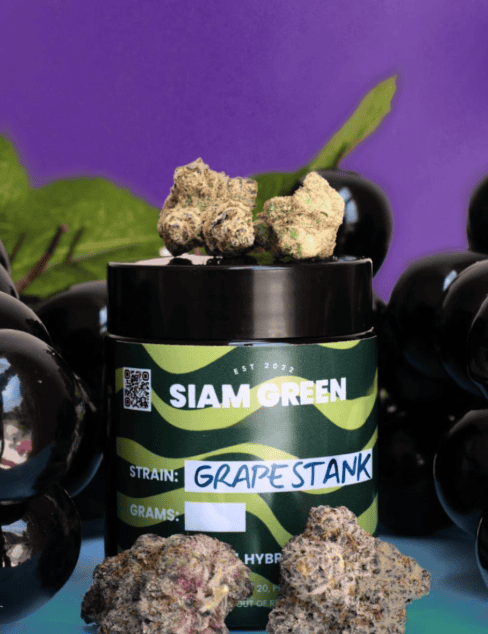
That’s why the flavor notes on a label often carry more information than the category heading above them. A grape-and-gas profile, a creamy apricot note, a sharp citrus edge: those are specific and checkable, and they track the actual aroma compounds in the flower. The research has moved in this direction too, leaning on terpene and cannabinoid content rather than the century-old sativa or indica shorthand. If you want the underlying detail, our explainer on why terpene profiles matter goes deeper.
Ask the team in person
Labels and menu headings only carry so much. At any Siam Green branch, the staff can walk you through terpene profiles and responsible use, whether cannabis categories are new to you or familiar ground. Five locations sit across Bangkok (Phrom Phong, Nana, Silom, Chinatown) and Koh Samui (Chaweng Beach), all open since 2022 and run to the same standards.
You can also reach Siam Green on LINE (@siamgreenco) with questions about terpene profiles and how the categories differ.
Find a branch near you: Phrom Phong, Silom, Nana, Chinatown, and Koh Samui (Chaweng).