
How Thailand Went From Ancient Cannabis Culture to Where We Are Today
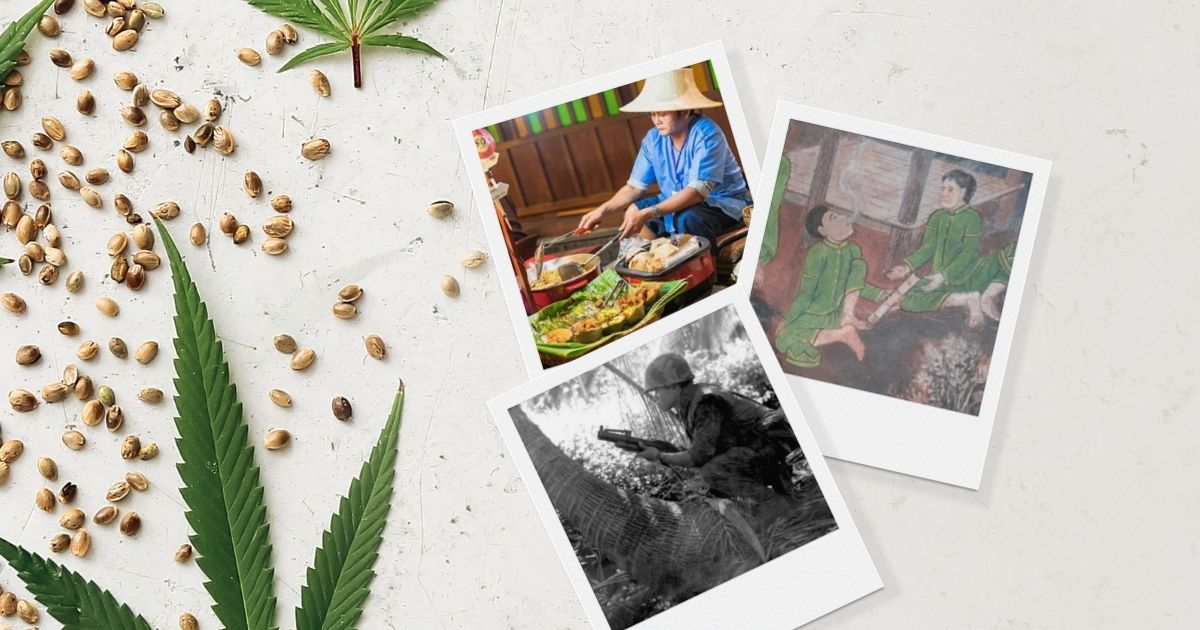
Reader Digest | Siam Green
How Thailand Went From Ancient Cannabis Culture to Where We Are Today.
The surprisingly long, mostly forgotten, and genuinely fascinating story of how cannabis shaped Thai culture long before it was ever a headline.
Most people think Thailand’s cannabis story started a few years ago when the headlines hit, the dispensaries opened, and the queues formed outside shops in Bangkok. But the real story starts several centuries earlier, in village kitchens, temple medicine rooms, and the notebooks of Thai healers who’d been using cannabis as a matter of course for generations.
Thailand has one of the oldest and least talked-about cannabis cultures in Asia. Here’s how it actually went from ancient use to prohibition to the green neon-lit shops today.
Where cannabis in Thailand actually came from
Cannabis grows wild across Central Asia and the Indian Himalayas, but its exact origins in Thailand are less clear. The most widely held theory is that it was brought to the region by Indian merchants, who also introduced the term ganja, derived from the Sanskrit word gunja. The linguistic trail is hard to ignore: the word for cannabis across Southeast Asia follows the same root almost exactly. In Thailand it’s kancha, in Cambodia kanhcha, in Laos kan xa, and in Vietnam can xa. Four countries, one origin!
What’s clear is that once cannabis arrived, it stayed. Not as a foreign import but as something that became fully integrated into Thai daily life. It was used for food, medicine, fibre, and textiles. Hemp handwraps were famously used in early Muay Thai fights, ending in shell-shaped knobs at the knuckles, before Western boxing gloves replaced them in the 1920s.
First Found in Food
Long before cannabis was a policy debate, it was a cooking ingredient. Thai cooks used cannabis leaves in soups, curries, and stir-fries particularly in rural and northern regions. The plant added flavour and, in small amounts, a mild relaxing effect that made it a natural fit for the end of a long working day. It wasn’t considered a drug. It was considered a herb, in the same category as lemongrass or galangal.
One of the most well-known examples is a traditional Thai dish called gaeng khi lek, a herbal curry that historically included cannabis leaves as one of several medicinal plant ingredients. Recipes like this were common in Thai households for centuries and only disappeared after criminalisation in the 20th century made them illegal to prepare.
→ Cannabis leaves were used in traditional Thai cooking for centuries
→ Treated as a culinary herb, not a controlled substance
→ Common in rural and northern Thai households as a daily ingredient
From Food to Medicine
Thailand’s traditional medicine system, Tamraa Phaet Thai, has been practised for over 700 years and draws on hundreds of plant-based preparations. Cannabis had a specific role in that system. It was used for aches, fevers, and digestion, and as a relaxant for people recovering from physical labour or illness. Thai healers documented its use in palm-leaf manuscripts that still exist today.
This wasn’t fringe or underground. The use of cannabis in Thai medicine was mainstream and well-documented; part of a broader herbal tradition that Thailand still draws on today in everything from pharmacy shelves to spa treatments. The plant fit naturally alongside turmeric, kaffir lime, and holy basil as something the body could use.
→ Cannabis documented in Thai medical manuscripts dating back centuries
→ Used for aches, fever, digestion, and physical recovery
→ Part of the same tradition as turmeric, holy basil, and other Thai medicinal plants
The Vietnam War: US soldiers and the legend of Thai Stick
During the Vietnam War, the United States built five military bases in Thailand, making it the primary hub for US troops in the region. At peak periods, estimates suggest there were more American soldiers in Thailand than in Vietnam itself where Bangkok and Eastern coastal provinces became the go-to destination when soldiers had leave. Cannabis was widely used among them, and many took the habit back to the US when they went home.
Despite the Cannabis Act of 1934, this period marked the beginning of Thailand’s underground cannabis trade and the global rise of Thai Stick. From the late 1960s through the 1980s, one of the largest cannabis smuggling operations in the world ran out of Bangkok, shipping hundreds of tons of high-quality Thai cannabis to markets from Australia to South Africa. By 2001, the US Drug Enforcement Administration acknowledged in a published report that Thailand had been the major cannabis producer in Southeast Asia throughout the 1970s and 80s. Thai Stick wasn’t just a product, it was a globally recognised brand, decades before dispensaries existed.
→ US soldiers on leave in Bangkok drove early demand for Thai cannabis in the Vietnam War era
→ Thai Stick became one of the most recognised cannabis products globally through the 70s and 80s
→ The DEA named Thailand the major cannabis producer in Southeast Asia during that period
How It Got Banned (because the world peer pressured us)
Thailand criminalised cannabis in 1934 under the Cannabis Act, and again more severely under the Narcotics Act of 1979. But the reasons had less to do with Thai culture than with international pressure. Following the US-led global war on drugs in the mid-20th century, many countries (including Thailand) adopted prohibition policies that didn’t reflect their own histories or traditions.
The result was that a plant Thais had used for generations became illegal almost overnight. Recipes disappeared. Traditional uses faded. And for roughly 80 years, cannabis went from household herb to criminal offence, not because Thailand decided it was dangerous, but largely because the international climate demanded it.
2022: A Policy Change -ish
When Thailand decriminalised cannabis in June 2022, the international media covered it as a bold new experiment. But for many Thais, particularly older generations and those with roots in traditional medicine, it felt more like a correction than a revolution. The plant had been part of Thai life for centuries. What changed was simply that you could buy it in a shop again.
Over 6,000 dispensaries opened across the country in the first year. Bangkok became one of the most accessible cities in the world for cannabis. And a conversation about how to use it responsibly (rooted in Thailand’s own history with the plant) started to emerge alongside the commercial boom.
→ Thailand was the first country in Southeast Asia to decriminalise cannabis
→ Over 6,000 dispensaries opened in the first year after decriminalisation
→ For many Thais, 2022 felt less like a new policy and more like a return to something familiar
Part of something that’s been here a long time.
At Siam Green Cannabis Co, we honor this deep-rooted legacy. Each item on our shelves undergoes rigorous lab testing and clear labeling, selected with the same meticulous intent that Thai practitioners applied to their herbal traditions for centuries that only now supported by modern technology. If you are exploring CBD, seeking a particular effect, or simply want to know the story behind the plant, our team can walk you through the details.